
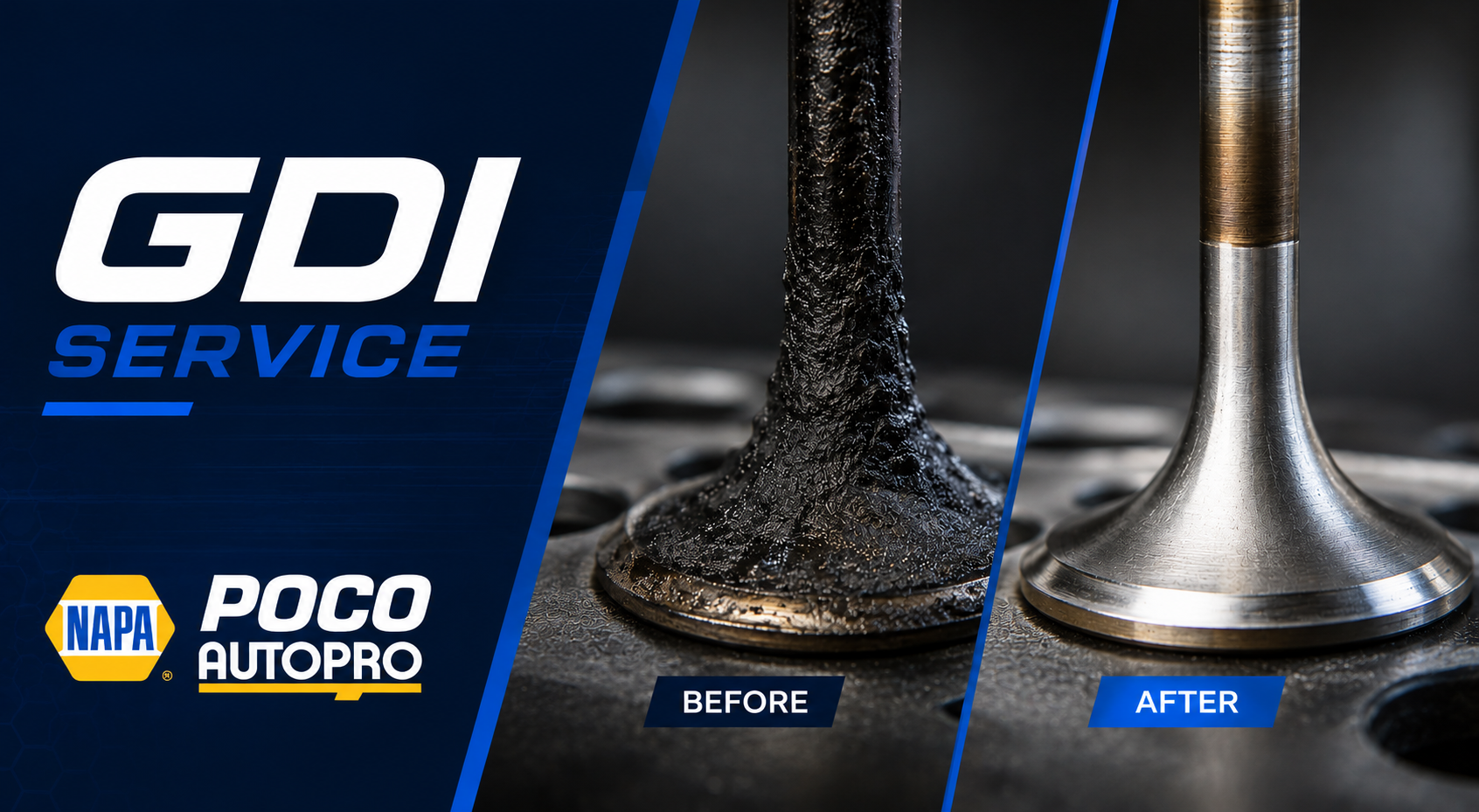
Gasoline Direct Injection (GDI) engines now power a significant portion of vehicles on the road — including models from Toyota, Honda, Ford, Hyundai, Kia, Mazda, GM, Volkswagen, BMW, and Mercedes-Benz. While GDI technology delivers real gains in fuel efficiency and power output, it also introduces a maintenance requirement that simply didn't exist with older fuel systems: intake valve carbon build-up.
At Poco NAPA AutoPro, we diagnose and service GDI-related drivability issues regularly. Here's what every GDI vehicle owner should understand.
Why GDI Engines Accumulate Carbon Deposits
Traditional port fuel injection systems spray fuel directly onto the intake valves. That fuel acts as a natural solvent, continuously washing away oil residue and combustion byproducts before they can harden.
GDI engines bypass the intake valves entirely — fuel is injected directly into the combustion chamber. The result is improved combustion efficiency, but the intake valves are left exposed to oil vapour from the crankcase ventilation system with nothing to clean them. Over time, those vapours bake onto the valve surfaces and form hardened carbon deposits.
This isn't a defect or a failure. It's an inherent characteristic of the GDI design, and it's predictable.
Symptoms of Carbon Build-Up
Carbon deposits restrict airflow into the combustion chamber. As build-up progresses, it can cause:
- Rough or unstable idle
- Engine misfires (often logged as P030X codes)
- Hesitation or stumble during acceleration
- Sluggish throttle response
- Reduced fuel economy
- Hard cold starts
- Loss of power under load
- Illuminated check engine light
Importantly, symptoms often develop gradually. Many drivers simply notice the vehicle doesn't feel as crisp or responsive as it once did — and assume it's just age. In many cases, carbon accumulation is the root cause.
Recommended Service Intervals
Because deposit formation is ongoing, preventative maintenance is significantly more effective — and more cost-efficient — than waiting for symptoms to appear.
At Poco NAPA AutoPro, we typically recommend a preventative GDI induction or intake cleaning service every 30,000–50,000 km, adjusted based on:
- Driving profile (short trips and stop-and-go traffic accelerate deposit formation)
- Oil change frequency and oil quality
- Any history of oil consumption or PCV system issues
- Cold climate operation
Some manufacturers have incorporated intake cleaning procedures into their maintenance schedules. We can confirm whether your vehicle's manufacturer has issued specific guidance.
A Real-World Example From Our Shop
We recently performed a GDI induction service on a 2012 Mercedes-Benz ML350 with 48,500 km on the odometer. The vehicle had no major drivability complaints — the owner simply wanted to stay ahead of the maintenance curve.
Before the service, the vehicle was averaging 12.2 L/100 km over normal mixed driving. After the service, over 1,650 km of tracked driving under comparable conditions, fuel consumption dropped to 11.2 L/100 km.
That's a reduction of 1.0 L/100 km — roughly an 8% improvement in fuel economy — from a vehicle that wasn't even presenting obvious symptoms. At current fuel prices, that kind of improvement adds up over time.
When Chemical Cleaning Is No Longer Sufficient
This is the critical point many vehicle owners don't learn until it's too late.
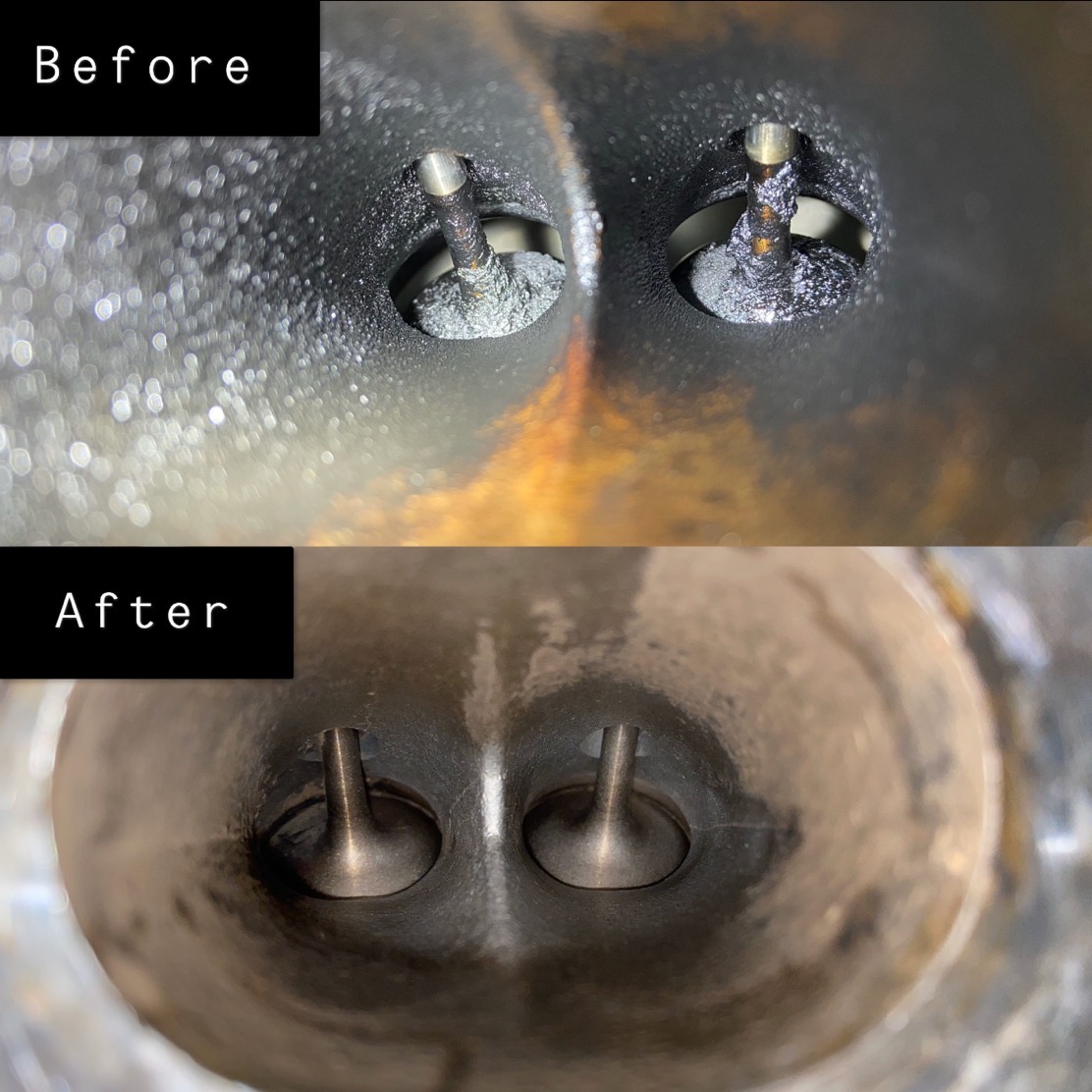
Chemical induction services are highly effective at dissolving soft, early-stage deposits. Once carbon has hardened and accumulated significantly on the intake valves, chemical treatments cannot fully remove it.
At that stage, the repair becomes substantially more involved:
- Intake manifold removal to access the valves directly
- Manual cleaning with specialized tools
- Walnut shell blasting — a media blasting process that removes hardened deposits without damaging valve surfaces
These procedures are labour-intensive and carry a considerably higher cost than preventative maintenance. We have seen cases where regular service intervals could have avoided this type of repair entirely.
Beyond cleaning: physical valve damage
There is a more serious consequence that goes beyond drivability symptoms and cleaning costs.
Hardened carbon deposits on intake valves can develop localized hot spots during combustion. Under certain conditions, these spots can reach temperatures high enough to glow — a phenomenon known as surface ignition or hot spot ignition. When a valve is subjected to repeated thermal stress at those temperatures, the heat can physically burn or erode the valve face and seat surface.
Once a valve is thermally damaged, no cleaning procedure will restore it. The engine will require valve replacement — and depending on the extent of the damage, potentially a more significant cylinder head repair.
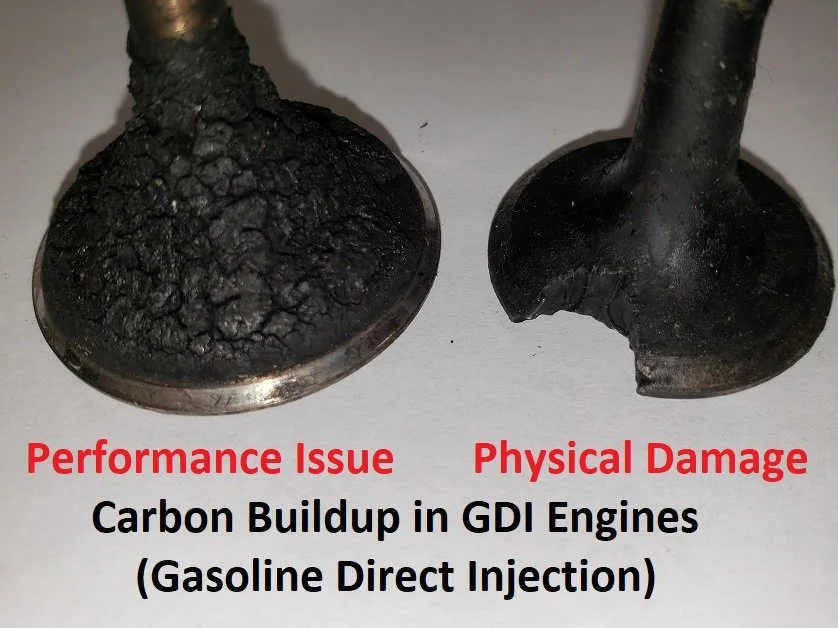
This is not a common outcome from moderate carbon accumulation, but it is a documented consequence of severe, long-term build-up that goes unaddressed. It represents the upper end of what deferred GDI maintenance can ultimately cost.
Reducing Deposit Formation Between Services
While some degree of carbon accumulation is unavoidable with GDI engines, you can slow the process by:
- Staying current on oil changes and using a quality oil grade appropriate for your engine
- Using Top Tier certified fuel when possible
- Allowing the engine to reach full operating temperature on longer drives — short cold trips are among the biggest contributors to accelerated build-up
- Addressing any oil consumption or PCV system issues promptly
Is Your Vehicle Due for GDI Service?
If your vehicle has been exhibiting any of the symptoms above — or if you own a GDI engine and haven't had an intake service performed — we recommend bringing it in for an inspection.
At Poco NAPA AutoPro, we offer GDI induction service and carbon removal for all makes and models — from chemical cleaning for early deposits to walnut shell blasting for advanced carbon removal. We'll assess the condition of your intake system and tell you honestly what's needed. Catching this early consistently leads to better outcomes, both for performance and for long-term repair costs.
We serve Port Coquitlam, Coquitlam, Pitt Meadows, and Maple Ridge.